Skip to content
Where you apply · Canada

Apply for the DTV at the Thai Embassy in Ottawa

Everything you need to apply for Thailand's Destination Thailand Visa (DTV) from Canada. The Royal Thai Embassy in Ottawa covers your online DTV application.

Royal Thai Embassy 📍 Ottawa, CanadaDTV applied for online

If you're in Canada and dreaming of working remotely from Thailand’s beaches or investing in your passion for Muay Thai, the Destination Thailand Visa (DTV) is your gateway. The Royal Thai Embassy in Ottawa is the diplomatic mission that covers your application — but here’s the key: the DTV is applied for entirely online through the Thai e‑Visa portal, and our team prepares and submits it for you. You won’t need to visit the embassy in person, but the Ottawa mission remains your official point of contact, and if it requests extra documents, you’ll deal directly with them. Understanding how the process works from a Canadian perspective sets you up for a smoother experience.

Who the Royal Thai Embassy in Ottawa Covers
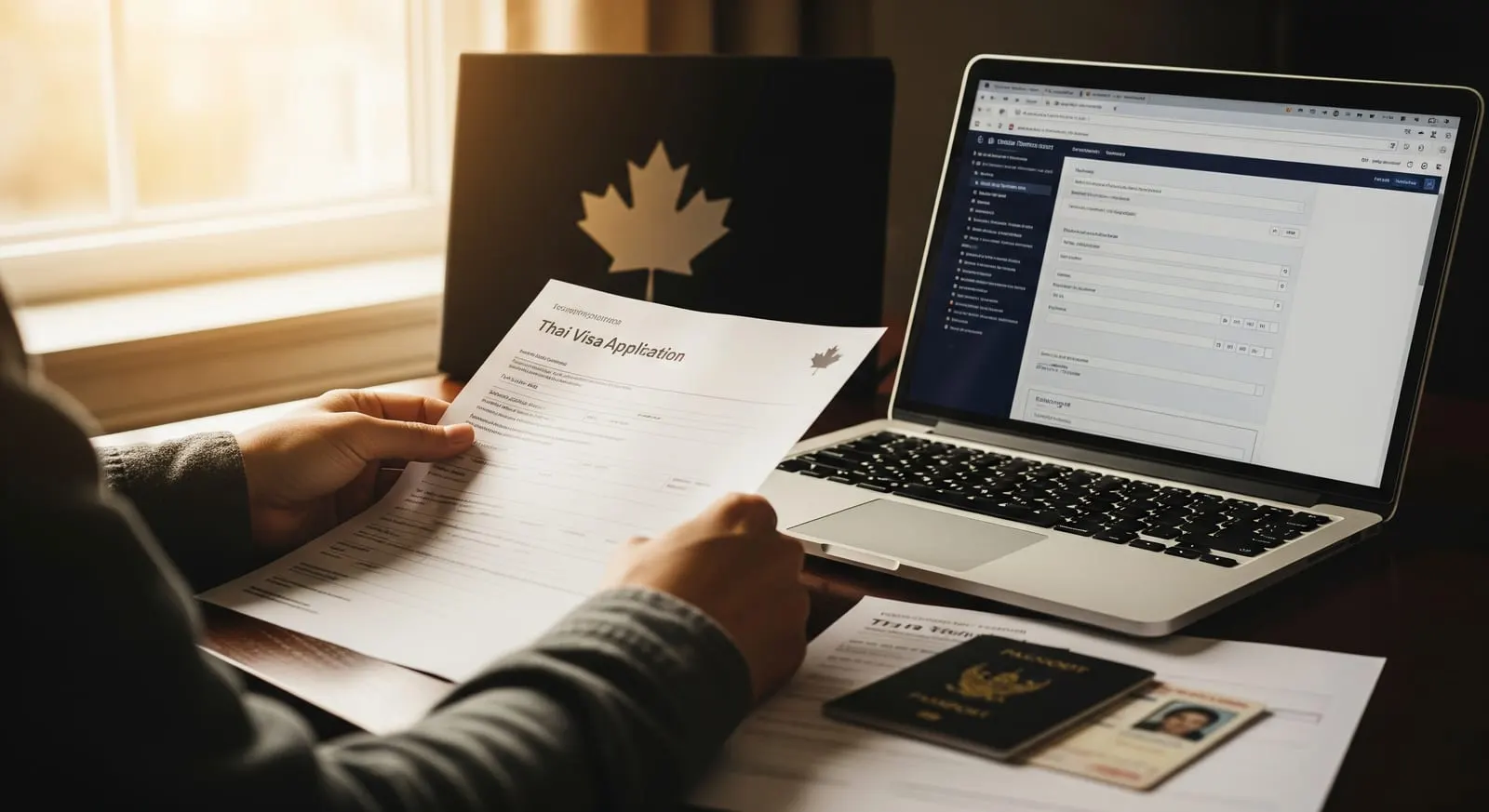
The Royal Thai Embassy in Ottawa is Thailand’s principal diplomatic mission in Canada, with consular jurisdiction extending across all provinces and territories. Whether you live in downtown Toronto, Calgary’s Beltline, or a small town in Nova Scotia, your DTV application will be routed to this embassy through the e‑Visa platform. That means you follow the same online process regardless of where in Canada you call home, and you’ll never need to travel to Ottawa for a visa appointment. The embassy’s role is to review the electronic submission and, if needed, send you a ‘Request for Further Document’ — so your post-application correspondence will come from the Ottawa team.

Ottawa — applying for the Destination Thailand Visa from Canada

Applying from Canada: Time Zones, Banking, and Flights

Canada’s Eastern Time Zone (ET) is about 12 hours behind Thailand. When you’re uploading documents late at night, the embassy may just be opening for business — but that doesn’t affect the 24/7 e‑Visa system. For your proof of funds, Canadian bank statements are perfectly acceptable; simply show a balance equivalent to 500,000 THB (~CAD $15,000). Since statements are usually in Canadian dollars, you can note the prevailing exchange rate on a cover sheet or let the conversion happen naturally in the reviewer’s mind. Most Canadian employers provide standard employment letters without the need for notarization or apostille, so your DTV evidence package should be straightforward. As for travel, while there are no direct flights from Ottawa Macdonald–Cartier (YOW) to Thailand, one-stop connections via Toronto Pearson (YYZ) or Vancouver (YVR) make the journey manageable. Once approved, you could be working from Chiang Mai in under 24 hours.

Ottawa’s Remote-Work Culture and the DTV

Ottawa may be a government town, but its Kanata tech hub and growing freelance community mean plenty of Canadians here are already living the remote-work lifestyle. The DTV is tailor-made for digital nomads, content creators, and independent consultants who want to swap the Rideau Canal for a beachside coworking space. Compared to Ottawa’s cost of living, Thailand offers extraordinary value — think of how far that 500,000 THB buffer goes when a high-quality meal costs a fraction of what you’d pay in ByWard Market. For creative professionals pursuing soft-power activities like Thai cooking or martial arts, the DTV also provides a legitimate, long-term option. It’s no surprise that interest from the National Capital Region and beyond is growing fast.

Who applies through this office

  • Applicants residing in Canada and the areas covered by this mission. See the full guide: DTV visa for Canada .
  • The DTV is applied for online — there is no in-person lodgement at this office, and our team can prepare and submit it for you.

How to apply for the DTV from Canada

  1. Make sure you qualify for the DTV: remote workers, freelancers, digital nomads, and those engaging in Thai soft-power activities (e.g., Muay Thai, cooking courses) are all eligible under the current framework.
  2. Prepare proof of finances showing at least 500,000 THB, which is approximately CAD $15,000 at today’s exchange rate. A recent Canadian bank statement or investment account statement works well.
  3. Gather the documents specific to your DTV category. For remote workers, this typically means an employment contract or business registration demonstrating you work outside Thailand.
  4. Send us your documents and our team completes the online application form and submits it on the official Thai e‑Visa portal for you, selecting the **Royal Thai Embassy in Ottawa** as the correct responsible mission so your submission is routed there.
  5. We settle the government visa fee securely through the portal’s integrated payment system as part of submission. The fee is charged in Thai baht at the day’s conversion rate.
  6. Keep an eye on your email (including spam folders) in case the Ottawa embassy sends a ‘Request for Further Document.’ Answer exactly what they ask for, and upload it to the portal without delay.
  7. To avoid common pitfalls, have our team at DTV Thai Visa review your application before submission. We’ll check your documents, help you present them optimally, and give you peace of mind — all for a flat fee starting from $139.

Frequently asked questions

Do I need to visit the Thai Embassy in Ottawa to apply for the DTV?

No, the DTV is applied for completely online. The Royal Thai Embassy in Ottawa covers your jurisdiction, but all steps — submission, document upload, fee payment, and correspondence — happen through the Thai e‑Visa portal. You only interact with the embassy if they send a document request digitally.

My bank statement is in Canadian dollars. Is that acceptable for the 500,000 THB requirement?

Absolutely. Canadian bank statements are standard. The equivalent of 500,000 Thai baht fluctuates with the exchange rate; at the time of this writing it's around CAD $15,000. You don’t need to convert the funds in your account — the Thai authorities will check the current exchange rate when reviewing your application.

What if I’m a permanent resident of Canada but not a citizen? Can I apply through the Ottawa embassy?

Yes. The DTV application is based on your current country of residence, not nationality. As long as you are legally residing in Canada, you can apply via the Royal Thai Embassy in Ottawa, regardless of your passport. You may need to show proof of your Canadian residency status.

Does the Thai Embassy in Ottawa require documents to be notarized or legalized?

Generally, no. Canadian documents in English — such as employment letters, bank statements, or university certificates — are accepted without notarization. If you have documents in French or another language, you may need to supply an English translation, but the embassy typically does not require extra certification beyond that.

I live in Vancouver. Do I still apply through the Ottawa embassy?

Yes. The Royal Thai Embassy in Ottawa has jurisdiction over all of Canada for e‑Visa purposes, so even if you’re on the west coast, our team selects ‘Ottawa’ as the correct mission when we submit your application on the portal. There’s no need to deal with a local consulate; everything is centralized.

Can I get a refund if my DTV application is refused by the Ottawa embassy?
Visa fees are non-refundable regardless of the outcome. That’s why it’s crucial to submit a complete and accurate application. Our team helps minimise the risk of refusal by reviewing your documents against the latest DTV requirements — and our service fee starting from $139 is a small price for that extra layer of confidence.

Apply for your 5-year DTV the easy way

We prepare, submit and follow up your application — apply from $139, with a 100% refund if denied (with the optional Denial Protection add-on).

Start your application

General guidance only — not legal advice. The DTV is applied for online via the Thai e-Visa portal; mission jurisdictions and requirements change over time. Confirm details on the official portal or let our team handle it for you.

Documents this office commonly asks for

Whichever office reviews your application, these are the requests applicants see most — and how to answer them: