Skip to content
Where you apply · Hungary

Apply for the DTV at the Thai Embassy in Budapest

Apply for the DTV from Hungary via the Thai e‑Visa portal. Expert support for applicants under the Royal Thai Embassy in Budapest — remote work and soft power.

Royal Thai Embassy 📍 Budapest, HungaryDTV applied for online

You’re based in Budapest and ready to make Thailand your part-time home for up to five years. The Royal Thai Embassy in Budapest is the diplomatic mission covering Hungary—so for DTV applicants, your online submission will be reviewed by this office. But rest assured: the Destination Thailand Visa is applied for completely online through the Thai e‑Visa portal; you won’t need to schedule any in‑person visit. Our team at DTVThaiVisa.com helps you prepare Hungarian‑specific paperwork and respond to embassy document requests, so you can focus on planning your adventure from the Danube to Thailand’s shores.

The Royal Thai Embassy in Budapest: Jurisdiction & Coverage

If you’re a resident of Hungary, Croatia, or Bosnia and Herzegovina, the Royal Thai Embassy in Budapest is the Thai diplomatic mission responsible for reviewing your DTV application. While the DTV is submitted online, the Thai e‑Visa system will route your case to this embassy based on your country of residence or current legal stay. This means consular officers in Budapest will assess your documents and may issue a “Request for Further Document” if anything needs clarification. For Hungarians and expats living in Budapest, Szeged, Pécs, or beyond, the embassy serves as the gatekeeper—but you’ll never need to hand‑deliver papers unless specifically instructed in rare circumstances.

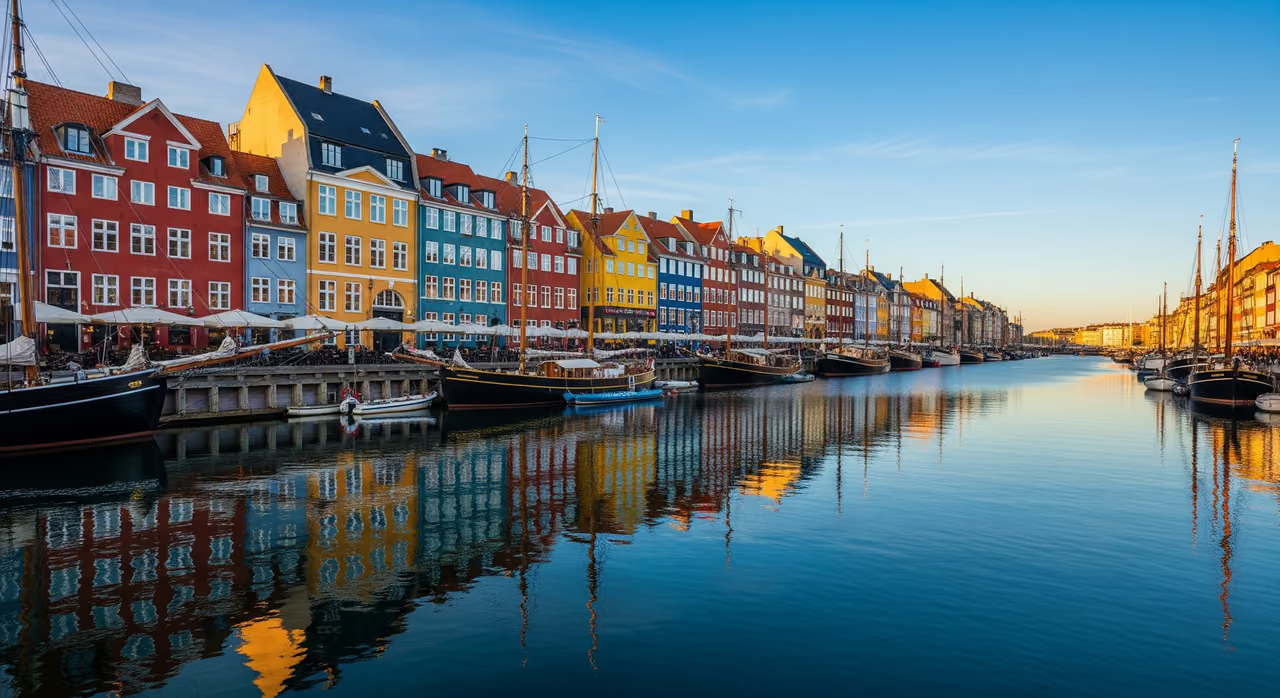
Budapest — applying for the Destination Thailand Visa from Hungary

Applying from Budapest: Time Zone, Flights & Lifestyle

Budapest’s Central European Time (UTC+1, +2 in summer) puts you just 5–6 hours behind Thailand, so communication with the e‑Visa system feels smooth. Once approved, you’ll find direct and one‑stop flights from Budapest Ferenc Liszt International Airport (BUD) to Bangkok or Phuket via carriers like Emirates, Qatar Airways, and Turkish Airlines, typically taking 12–15 hours. As a DTV holder, you’ll appreciate the growing community of remote workers in Budapest’s ruin bars and co‑working spaces, many of whom split their year between Hungary’s affordable capital and Thailand’s digital nomad hubs like Chiang Mai. The lower cost of living here makes it easy to save the required 500,000 THB (~$15,000) and budget for frequent trips.

Document Prep in Hungary: What to Keep in Mind

When gathering your DTV evidence, Hungarian bank statements should clearly show the equivalent of 500,000 THB—in forint (HUF) or euros—saved in a bank account. Most Hungarian banks provide statements in Hungarian by default; request an English version or arrange a certified translation to avoid delays. If you’re employed by a Hungarian company and work remotely, your employment contract must explicitly state your remote arrangement; a letter from HR in English is ideal. Freelancers with a Hungarian tax number (adószám) should include a portfolio of contracts, recent invoices, and a translated excerpt of your registration with NAV (the tax authority). While the embassy doesn’t require notarization, having official translations by an OFFI‑accredited translator can streamline the review process.

Who applies through this office

  • Applicants residing in Hungary and the areas covered by this mission. See the full guide: DTV visa for Hungary .
  • The DTV is applied for online — there is no in-person lodgement at this office, and our team can prepare and submit it for you.

How to apply for the DTV from Hungary

  1. Confirm your DTV category – In Hungary, you’ll likely apply as a digital nomad (remote worker), freelancer, or under a soft‑power activity (Muay Thai, cooking, seminars). Check that your work or activity fits one of the approved categories.
  2. Prepare proof of funds – 500,000 THB (~$15,000) – Convert the amount into forint or euros and save it in a Hungarian bank account. Obtain a recent statement and have it translated into English or Thai if necessary.
  3. Gather your category evidence – Remote workers: employment contract showing remote permission. Freelancers: contracts, invoices, and a cover letter explaining your business. Soft‑power enthusiasts: event registration, course enrollment, or letter from a Thai organization.
  4. We apply online via the Thai e‑Visa portal – Send us your documents and our team completes and submits the DTV application on the official Thai e‑Visa portal for you, selecting the “Royal Thai Embassy in Budapest” as the responsible mission. We upload all documents, including your passport bio‑page and a recent photo.
  5. Respond to any “Request for Further Document” – If the embassy contacts you for additional information, you’ll receive an email. Provide exactly what they ask for, well‑translated. Our experts can help you craft a prompt response.
  6. Let DTVThaiVisa.com review everything first – For peace of mind, our team checks your documents, translations, and application before submission to avoid common pitfalls. Service plans start from just $139.
  7. Receive your e‑Visa approval – Once approved, the DTV will be sent electronically. Print a copy and travel to Thailand within the validity period. You can then extend your stay for up to 5 years, with 180‑day entries.

Frequently asked questions

Do I need to visit the Royal Thai Embassy in Budapest in person to apply for the DTV?

No. The DTV is applied for online exclusively through the Thai e‑Visa portal. The embassy is simply the mission that reviews applications from residents of its jurisdiction. You will not attend an in‑person interview or drop‑off; in rare cases, they might ask you to mail additional documents.

I’m a Croatian citizen living in Hungary – can the Budapest embassy process my DTV?

Yes. The Royal Thai Embassy in Budapest covers Hungary, Croatia, and Bosnia and Herzegovina. If you legally reside in any of those countries, your application will be reviewed by this mission. Our team makes sure the correct embassy is selected when we submit your e‑Visa application.

What format should my Hungarian bank statement be in?

Statements should clearly show your name, account number, and a balance meeting the 500,000 THB equivalent. While many applicants submit PDF statements in English from Hungarian banks, if yours is only in Hungarian, get an official translation. A 3‑month statement is typical, but the embassy may request more.

I work remotely for a US company, paid in euros. How do I prove that for the DTV from Hungary?

You need an employment contract stating you can work remotely and a letter from your employer that you can present. Pay slips and bank statements showing salary deposits help. As you’re in Hungary, you should also include your Hungarian residence permit or proof of legal status to show why you’re applying from here.

Is the 500,000 THB requirement flexible if I have a job offer in Thailand?

No. The financial requirement is a standard part of the DTV application and must be demonstrated with a bank statement regardless of employment. The amount is fixed at 500,000 THB (around 5.2 million HUF or €13,500, depending on exchange rates).

How long does it take to get the DTV after applying from Budapest?

Processing times vary depending on embassy workload and the completeness of your file. We advise applying well ahead of your intended travel. Our team helps compile a complete application to minimise back‑and‑forth requests and delays.

Can I use my Hungarian accountant’s certification instead of a bank statement?
No. The embassy requires a bank statement from a recognised financial institution, not a letter from an accountant. Make sure the statement shows a balance of 500,000 THB or more in easily accessible funds.

Apply for your 5-year DTV the easy way

We prepare, submit and follow up your application — apply from $139, with a 100% refund if denied (with the optional Denial Protection add-on).

Start your application

General guidance only — not legal advice. The DTV is applied for online via the Thai e-Visa portal; mission jurisdictions and requirements change over time. Confirm details on the official portal or let our team handle it for you.

Documents this office commonly asks for

Whichever office reviews your application, these are the requests applicants see most — and how to answer them: