
Skip to content
Thai Embassy Document Request · Dependent & Family

Proof of Relationship to the DTV Holder

Confused by the dtv dependent proof of relationship request? Our guide shows what to submit: marriage, birth or adoption certificate, plus spouse invitation.

DTVDTVThaiVisa 15 min read

If you've received a “Request for Further Document” asking for proof of relationship to the main DTV holder, you're in the right place. This is one of the most critical pieces of your dependent application, but it's entirely manageable once you know exactly what the embassy expects. We'll walk you through the correct documents—marriage, birth or adoption certificate—and, for spouses, the essential invitation letter.

A couple reviewing their marriage certificate and Thai visa application on a laptop

What the embassy asked

The embassy or consulate sends this request to confirm that you are legally entitled to apply as a dependent of a Destination Thailand Visa holder. Without solid proof, your application cannot proceed.

“Proof of relationship to the DTV visa holder (e.g., a copy of marriage certificate/ birth certificate / certificate of adoption)”

Why the embassy asks for this

A DTV dependent status is not independent—it exists solely because you are the recognised spouse or child (under 20) of the main DTV holder. The reviewing officer must see hard documentary proof of that family tie before issuing the dependent visa. For spouse applicants, the invitation letter requirement further verifies that the named holder sponsors you and confirms where in Thailand you will live. Chinese documents are held to a stricter standard, so dual-authentication is mandatory.

How to provide it correctly

  1. Identify the single document that proves your tie: marriage certificate for spouse, birth certificate for biological child under 20, or certificate of adoption for adopted child. Submit only that one—not all three.
  2. Ensure the certificate is in Thai or English. If it’s in any other language (e.g. Chinese, Russian, Arabic), obtain a certified translation and have both the original and translation legalised/authenticated before uploading.
  3. Check name consistency: the names on the relationship certificate must exactly match the passports of both you and the DTV holder. If a maiden name, transliteration or name-change is involved, add the supporting name-change document.
  4. Scan the relationship certificate in full colour, every page, stamp, seal and signature clearly visible, and keep the original in case the office asks to see it.
  5. For a spouse: prepare the DTV holder’s invitation letter exactly as requested—a signed letter stating the specific address of stay in Thailand, with a copy of the holder’s ID and passport (bio-data page) attached.
  6. For China applicants: have your marriage/birth/adoption proof dual-authenticated (notarised then authenticated for cross-border use) and include the spouse invitation letter. Both are mandatory.
  7. Apply through the Thai e-Visa portal (thaievisa.go.th) as a separate "DTV Dependent" application—only after the main holder’s DTV has been approved—and upload the relationship proof in the designated slot.
  8. When replying to a “Request for Further Document” email, upload ONLY the exact document(s) named in that email (and if asked, the invitation letter), nothing extra, before the deadline.
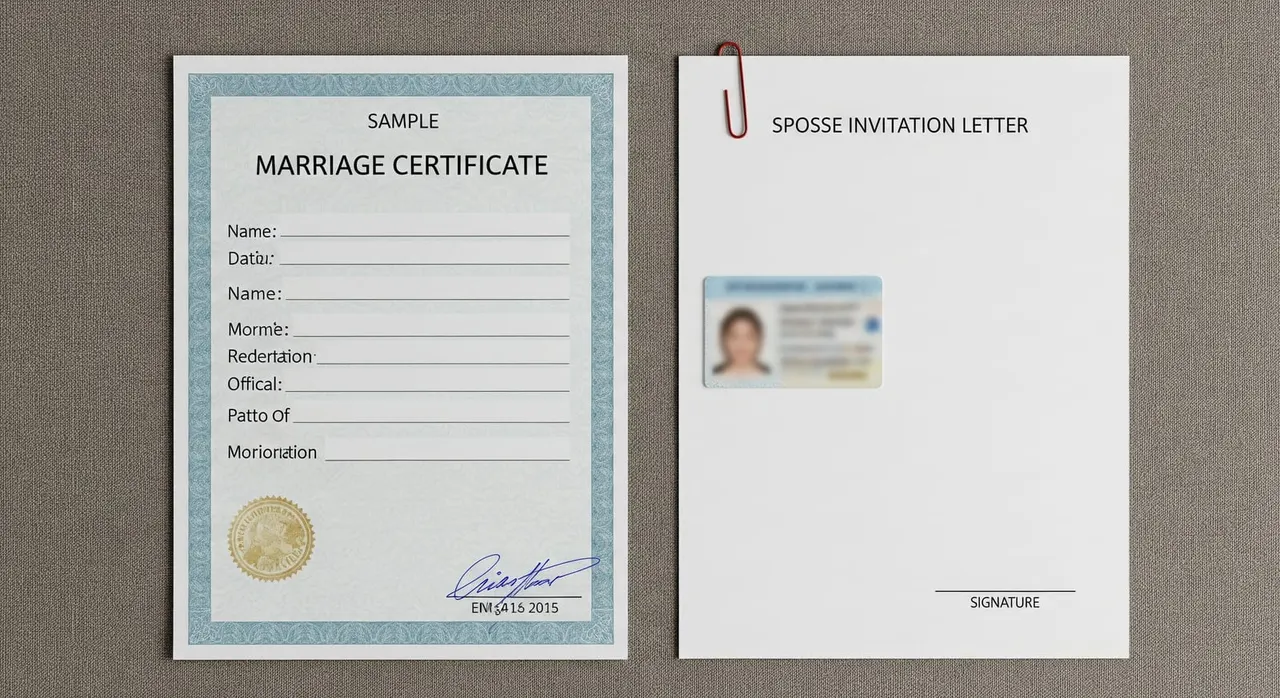
A sample marriage certificate and a spouse invitation letter with signature and attached ID

Common mistakes that cause rejection

  • Assuming a marriage certificate is optional because you’ve lived together for years—the DTV does not recognise common-law or de facto relationships.
  • Uploading a foreign-language certificate without a certified translation and legalisation.
  • Treating the husband’s invitation letter as a generic template—omitting the specific Thai address, signature, or holder’s ID/passport.
  • Sending all three relationship documents (marriage, birth, adoption) “to be safe” instead of just the one that matches, and adding unrequested extras.
  • China applicants stopping at simple notarisation without completing dual-authentication, or sending relationship proof without the mandatory spouse invitation letter.
  • Re-uploading the same flawed certificate after a rejection without fixing the underlying issue (translation, legalisation, name mismatch)—in our experience, since around May 2026, a weak re-application after a rejection has been harder to clear.

Myth

“We’re in a long-term partnership, so that counts as a dependent relationship.”

Fact

The DTV dependent route strictly requires proof of a legal relationship—a registered marriage certificate, not an unregistered or common-law partnership. Photos, joint leases, or joint bank accounts are not accepted as proof of relationship to the DTV holder.

Frequently asked questions

Can I bring my partner on the DTV without a marriage certificate?

No. The DTV dependent route requires proof of a legal relationship; the officer’s example list is marriage certificate, birth certificate, or certificate of adoption, and an unregistered or common-law partnership is not accepted as proof of relationship to the DTV holder.

My marriage certificate is in Chinese—is that enough?

Not on its own. Documents must be in Thai or English; a Chinese certificate needs a certified translation that is then legalised/authenticated. For China applicants, it must also be dual-authenticated and paired with a spouse invitation letter.

What exactly must the invitation letter from my husband contain?

Per the embassy request, it must be a letter from your husband with his signature, state the specific address of stay in Thailand, and have his ID and passport attached—a generic letter without the address, signature or attachments is commonly sent back.

Can I apply as a dependent at the same time as my spouse’s main DTV?

No. Each dependent files a separate 'DTV Dependent' application on the Thai e-Visa portal, and you can only apply once the main holder’s DTV has been approved, since the relationship you must prove is to an existing holder.

My relationship proof was rejected—can I just send it again?

Read the Request for Further Document carefully; rejections almost always point to a fixable issue (missing translation, missing legalisation, name mismatch, or an incomplete invitation letter). Fix that specific problem first, then resubmit only the requested document—in our experience, since around May 2026, simply resending an unchanged file has been harder to clear.

Is the proof of relationship enough by itself for a spouse?

Often not. For spouses the officer also requests a signed invitation letter from the DTV-holder spouse stating the specific Thai address with their ID and passport attached, and China applicants additionally need the relationship proof dual-authenticated.

What if my name changed after marriage—will my birth certificate still work for a child?

If your name changed, you must include the name-change document (e.g., marriage certificate showing the new name) to link the child's birth certificate to your current passport. The names must match or be explained.

Get this document right the first time

Let our team prepare and check your response to the embassy — apply from $139, with a 100% refund if denied (with the optional Denial Protection add-on).

Start your application

General guidance only — not legal advice. Thai embassy requirements vary by office and change over time; always confirm the exact wording in your own request email, or let our team check it for you.

Related document requests