
Skip to content
Thai Embassy Document Request · Logistics

Motivation / Introduction Letter for the DTV

Struggling with the DTV motivation letter request? Get a proven DTV motivation letter example and expert advice on what the embassy really wants — occupation, income, and plans.

DTVDTVThaiVisa 13 min read

Did you just receive a request from the Royal Thai Embassy for a motivation letter ? Don’t panic. This guide shows you exactly how to craft a response that satisfies the embassy, with a dtv motivation letter example covering your occupation, remote income, and proof of funds. We’ll walk through the real requirement, step-by-step instructions, and how to avoid a rejection.

An applicant preparing their DTV motivation letter on a laptop, with supporting documents like passport, bank statements, and employment contract spread out on a desk, Thai flag in the background.

What the embassy asked

The email you received is a standard ‘Request for Further Document’ sent via the Thai e-Visa portal. It asks for a personal letter explaining who you are, your occupation, and how you’ll fund your stay—plus specific proof of earnings. This is exactly what the embassy words look like.

“A letter introduce yourself what do you do for living in UK and how this would support yourself while you are travelling and staying in Thailand and a proof of your earning eg. Employment contract / Payslip or Invoice (last 3 months) / Company Register.”

Why the embassy asks for this

The Destination Thailand Visa application form often captures only a brief occupation line like ‘I work online.’ When the reviewing officer can’t clearly see your employment or income source, they issue this request. The motivation letter bridges that gap, providing a human narrative that ties your financial documents to your identity and plans. It confirms you meet the financial requirement of at least 500,000 THB (~$15,000) and demonstrates a legitimate long-term purpose.

Because the same officer may later call you for an interview, this letter becomes your script—its claims must align perfectly with what you say in person and the original documents you bring.

How to provide it correctly

  1. Begin with a one-line self-introduction: your full name (as in passport), nationality, age, and the DTV sub-category you applied under (e.g., Workcation/remote work).
  2. State plainly what you do for a living: your job title, employer or clients, the country they are based in, and confirm the work is fully remote and permitted from Thailand. Avoid vague phrases like ‘I work online.’
  3. Explain how this supports you in Thailand: mention your approximate monthly income, that it continues uninterrupted from abroad, and that you meet the 500,000 THB (~$15,000) requirement evidenced by your last 3 months of bank statements.
  4. Name your proof of earnings and attach exactly what the email requested—employment contract, payslips or invoices for the last 3 months, or company registration—matching your employment type.
  5. Add a short, concrete plan for your time in Thailand: where you intend to base yourself initially (e.g., a hotel for the first month then a lease) to show a genuine long-term stay, not a tourist visit.
  6. Keep the letter to one page, in English or Thai, with all dates, income figures, and employer details matching every other document in your file.
  7. Sign and date the letter, save as a clean PDF, and upload only this letter plus the named proof of earnings. Do not attach extra documents.
  8. If also summoned for an interview, note the exact date and location, and prepare to bring your passport and supporting documents in original version, with answers consistent with the letter.
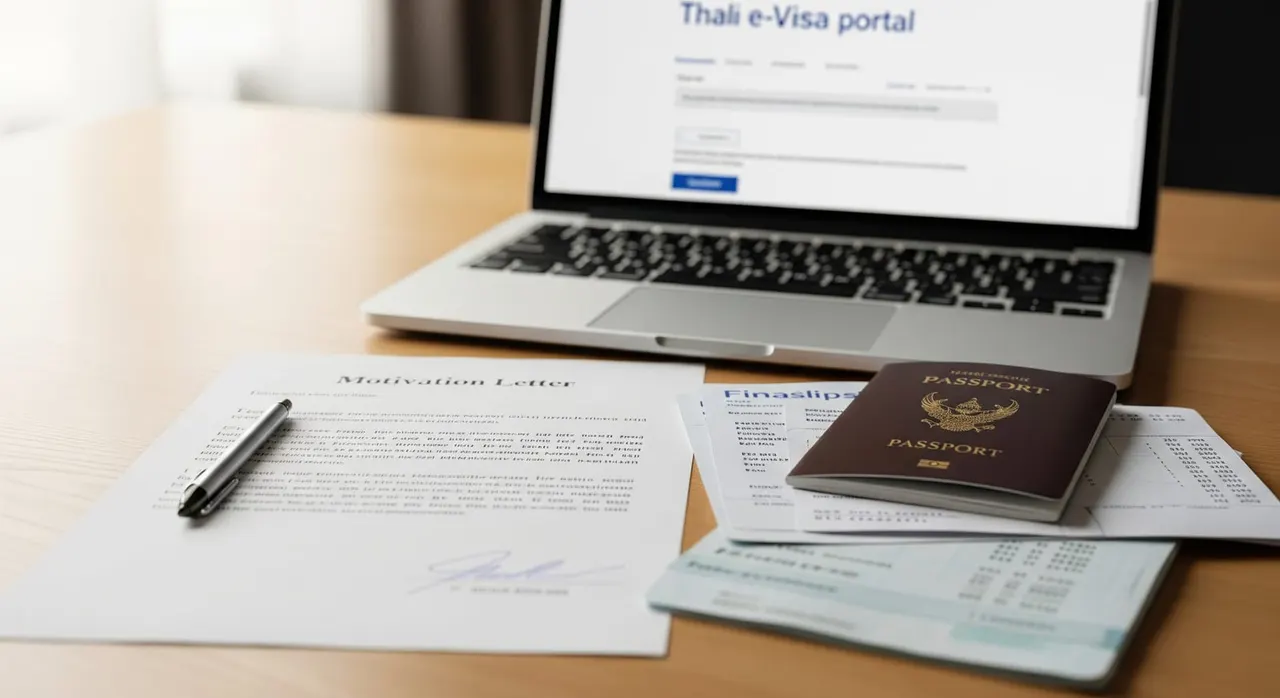
A close-up of a signed motivation letter on a desk, next to bank statements, payslips, and a passport, with a laptop showing the Thai e-Visa portal.

Common mistakes that cause rejection

  • Writing a vague letter that only says ‘I work online’—the very gap that triggered the request.
  • Skipping the required proof of earnings and sending only the motivation letter.
  • Mismatching dates or figures between the letter and your bank statements/employment contract.
  • Assuming one fixed local-currency threshold applies globally; some consulates interpret the 500,000 THB rule differently.
  • Giving inconsistent answers during an interview that contradict the letter.
  • Uploading extra, unrequested documents or missing the response deadline on the e-Visa portal.

Frequently asked questions

Is a motivation letter officially required for the DTV?

It is not on the standard checklist, but embassies routinely issue a ‘Request for Further Document’ asking you to ‘provide a motivation letter’—a letter introducing yourself, what you do for a living and how it supports you in Thailand—when your occupation or funding isn’t clear from the file. Once asked, it is mandatory for that application.

What exactly should the letter say?

One page covering your name and nationality, your job/clients and the country they’re in, that the work is remote and approved for Thailand, and that your income plus the 500,000 THB (~$15,000) on your last 3 months of statements will support your stay. Attach the proof of earnings they named.

What proof of earnings goes with the letter?

Whatever the email listed for your case—an employment contract and/or payslips for the last 3 months for employees, invoices for the last 3 months for freelancers, or a company register/registration for business owners. Send only those, not extras.

Does the letter need to be in Thai?

No. English or Thai is accepted. Any document in another language must come with a certified and legalized translation; some consulates also recommend a certified translation office.

They asked me to attend an interview — how does the letter help?

Attend the named Consular Section on the given date only, bringing your passport and supporting documents in original version. The letter is effectively your script: answer questions about your work, income and plans exactly as written, and be ready to show your live bank balance.

If my application is denied after a weak letter, can I just reapply?

You can, but in our experience, since around May 2026, re-applying after a rejection has felt harder, so it’s better to make the first letter accurate and consistent. A 100% refund if denied is available only with the optional paid Denial Protection add-on.

Get this document right the first time

Let our team prepare and check your response to the embassy — apply from $139, with a 100% refund if denied (with the optional Denial Protection add-on).

Start your application

General guidance only — not legal advice. Thai embassy requirements vary by office and change over time; always confirm the exact wording in your own request email, or let our team check it for you.

Related document requests