
Skip to content
Thai Embassy Document Request · Dependent & Family

Certified & Legalized Marriage Certificate Translation

DTV dependent visa? Learn how to get your marriage certificate translation certified and legalised correctly — the exact chain the embassy needs, with no costly missteps.
DTVDTVThaiVisa 13 min read

If you received a Request for Further Document for your spouse's DTV dependent application asking for an English translation of your marriage certificate that is certified or legalised by the relevant embassies , you're in the right place. This is the most common stumbling block for dependents. We'll show you precisely what the embassy expects and how to get your certified & legalised marriage certificate translation accepted – no guesswork.

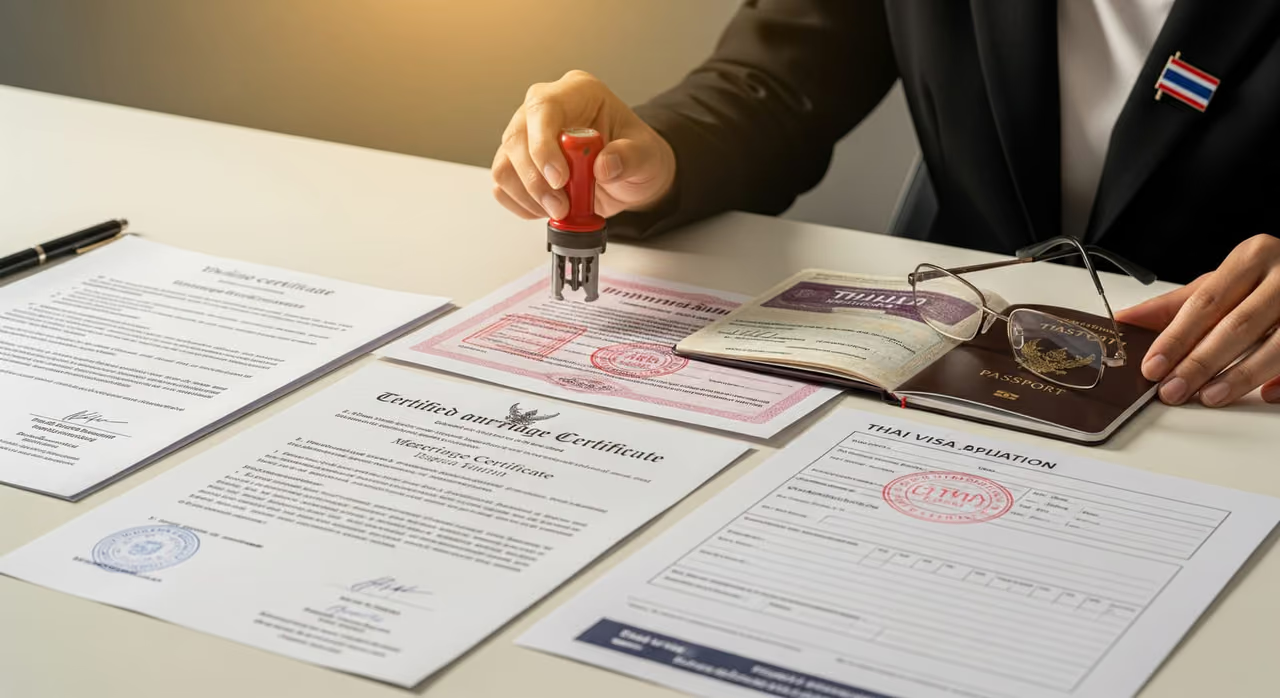
A realistic editorial scene illustrating a certified and legalised marriage certificate translation being prepared for a Thai visa application

What the embassy asked

The reviewer handling your DTV dependent application needs to verify your spouse's relationship to the primary visa holder. They've specifically asked for an English translation of your original marriage certificate that has been certified or legalised.

“A English translation of your original marriage certificate and it must be certified or legalised by the relevant embassies in London please.”

Why the embassy asks for this

Your marriage certificate is the core proof that your spouse qualifies as a dependent under the DTV scheme. Thai immigration requires all supporting documents to be in Thai or English. If your certificate is in another language, a plain translation isn't trustworthy enough — the reviewer needs an official certification or a full legalisation chain so they can verify the document's authenticity. This is the single most common reason a dependent application stalls, but it's also one of the most straightforward to fix when you follow the right steps.

How to provide it correctly

  1. Read the exact wording of the Request for Further Document email: the reviewer asked for an English translation of your ORIGINAL marriage certificate that is certified OR legalised by the relevant embassies in London. Match your submission to that wording exactly.
  2. If your marriage certificate is not in English, have it translated by a professional or authorised translator who signs a certification statement (commonly worded 'Certified Correct Translation') with their name, signature and date.
  3. Legalise the original certificate first by obtaining an apostille from the FCDO Legalisation Office (UK applicants; for other countries follow the equivalent process).
  4. Take the apostilled certificate and the certified English translation (if needed) to the Royal Thai Embassy Consular Section, 29-30 Queen's Gate, London SW7 5JB for Thai consular legalisation. Submissions are accepted Mon-Fri 09:00-12:00, cost GBP 10 per document by card (no AMEX), and takes about 3 working days excluding postage.
  5. Scan the fully legalised package as a single clear PDF — this must include the original certificate, the apostille page, the embassy legalisation stamp, and the certified translation. Upload it via the Thai e-Visa portal or attach it in your reply email exactly as the reviewer instructed.
  6. Reply only with the marriage-certificate documents requested. Do not add bank statements, photos or other unrequested items.
  7. Keep the originals safe; the reviewer asked for a translation of your ORIGINAL certificate, so the chain must trace back to the genuine documents, not photocopies.
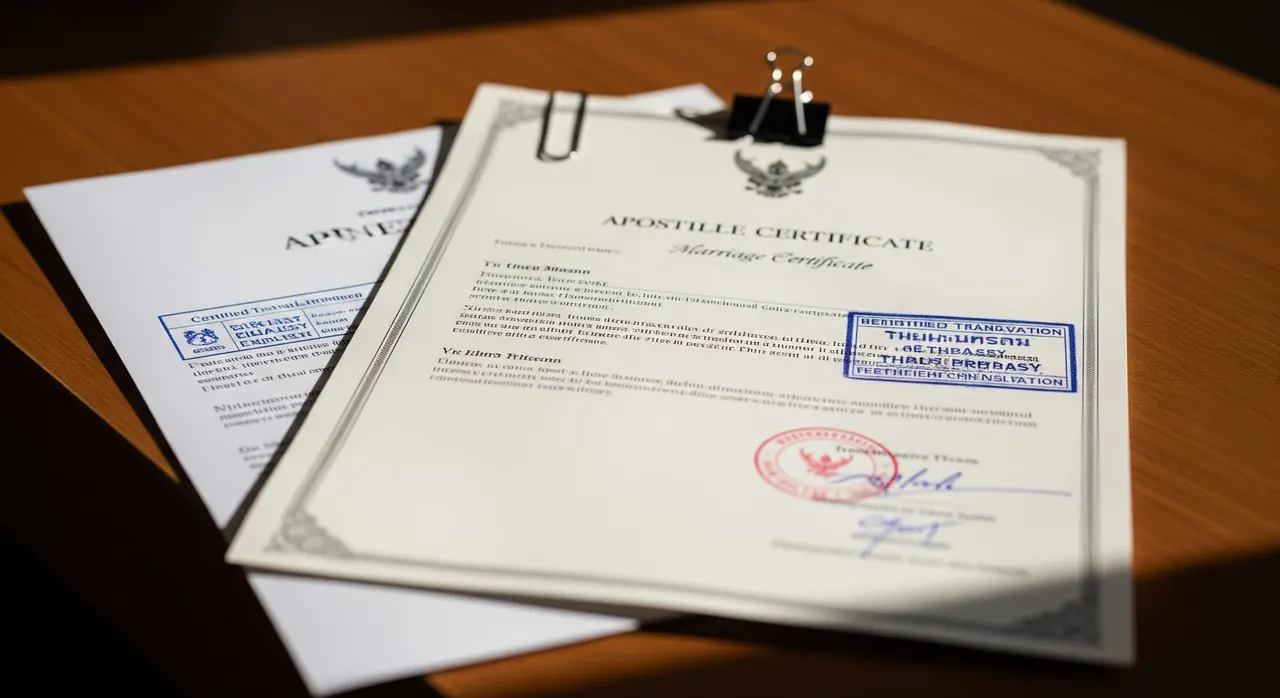
A document visual showing a marriage certificate with an apostille, Thai embassy stamp and a separate certified translation page bundled together

Common mistakes that cause rejection

  • Assuming an English-language certificate needs nothing further — the reviewer can still require legalisation by the relevant embassies.
  • Stopping at the FCDO apostille and skipping the Thai embassy legalisation, leaving an apostille-only document Thailand won't accept for a translated document.
  • Using a non-certified translator or a DIY translation, so no official certification statement appears on the page.
  • Letting the translated names or marriage date drift from the passport or original certificate, creating a mismatch.
  • Over-submitting: sending the certificate alongside unrequested bank statements, photos or a lease, which violates the 'only what was asked' rule.
  • Not budgeting time for the legalisation process — the embassy's 3-working-day turnaround and limited submission hours can cause a miss of the reviewer's deadline.

Frequently asked questions

Does my marriage certificate need both translation AND legalisation?

If it is not in Thai or English, you need a certified English translation, and the reviewer's email typically asks that the translation also be certified or legalised by the relevant embassies in London. So plan for the full chain: certified translation plus consular legalisation.

My certificate is already in English — is that enough?

Not always. Even an English-language certificate can trigger a request for certification or legalisation by the relevant embassies in London. Be ready to add the apostille and Thai embassy legalisation if the reviewer asks.

Is a UK apostille on its own accepted?

No. For documents requiring translation, Thailand does not accept an apostille alone. You must first obtain the UK apostille from the FCDO and then legalise the document at the Royal Thai Embassy in London.

Where and how do I get the Thai embassy legalisation in London?

Visit the Royal Thai Embassy Consular Section at 29-30 Queen's Gate, London SW7 5JB. Submissions are accepted Monday to Friday, 09:00–12:00. The fee is GBP 10 per document, payable by card (no AMEX). Expect a processing time of approximately 3 working days, plus postage if you send by mail (include a pre-paid Special Delivery return envelope).

Should I send extra documents to be safe?

No. Reply only with the exact marriage-certificate documents the reviewer requested. Sending unrequested extras can complicate or slow the review and may lead to rejection.

What happens if I get this wrong and have to re-apply?

If you receive a rejection, correct the specific issue — ensure you provide a properly certified translation with the full legalisation chain and matching names — before resubmitting. In our experience, since around May 2026, re-applying after a rejection has become more difficult, so it's best to get the document right the first time.

Get this document right the first time

Let our team prepare and check your response to the embassy — apply from $139, with a 100% refund if denied (with the optional Denial Protection add-on).

Start your application

General guidance only — not legal advice. Thai embassy requirements vary by office and change over time; always confirm the exact wording in your own request email, or let our team check it for you.

Related document requests