



Employment Contract / Remote-Work Eligibility Letter
The embassy asked for your DTV remote-work eligibility letter. Learn how to submit the right employment contract or employer letter to meet the DTV remote-worker rules.

What the embassy asked
“A letter from your company confirming your eligibility for remote work or digital nomad status.”
Why the embassy asks for this
How to provide it correctly
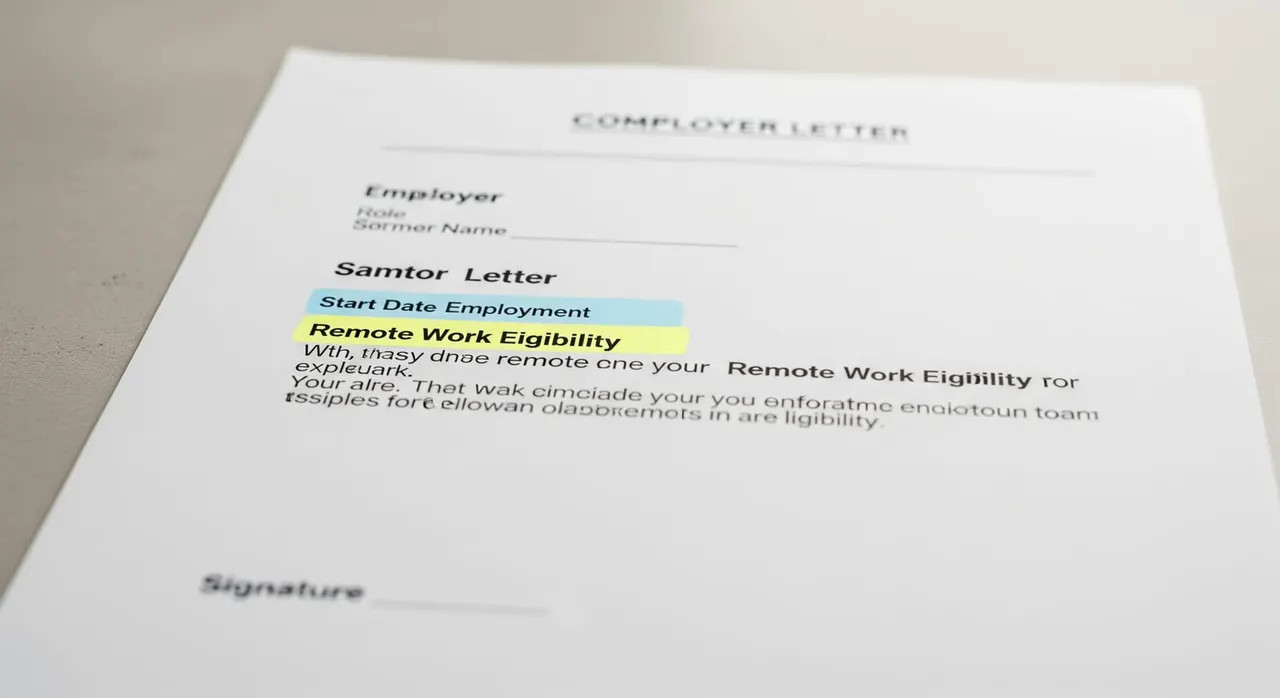
Re-read the embassy email and supply ONLY the document(s) named. If they ask for a letter, send the letter; if they also ask for the business registration, add that too. Do not pad the reply with extra unrequested files. Get a fresh employer letter on company letterhead that explicitly states you are permitted to work remotely / as a digital nomad from any location including Thailand, names your role and start date, and is signed by an authorized representative with their name, title and contact details—dated within the last few weeks. If you send the employment contract or an employment certificate instead of (or alongside) the letter, make sure it is signed by both parties, currently in force (not expired), and contains a clear remote-work clause. An old contract with no remote language is the single most common trigger for this request. Freelancers without one employer should instead submit a professional portfolio plus 2–3 active client contracts or invoices that visibly show digital-nomad / remote / freelancer status, so the file doesn’t look like a single thin client relationship or disguised employment. Obtain the company’s business registration / incorporation certificate or business license showing the firm is registered OUTSIDE Thailand, and confirm the employer name on it matches the name on your contract and letter exactly. Confirm every document is in Thai or English. For anything in another language, attach a certified translation signed by a licensed translator (legalized where your office requires it). Have your 500,000 THB (~$15,000) financial proof ready and consistent with the income story, since officers often cross-check the employment documents against the bank balance. Re-upload the requested PDFs/JPEGs in your existing application on the Thai e-Visa portal (thaievisa.go.th) under the same case number—do not open a new application, and reply within the deadline stated in the email.
Myth
If my contract already says I can work remotely, I don’t need a separate letter.
Fact
Common mistakes that cause rejection
Submitting the same original contract again after a rejection without adding the missing remote clause, fresh dates, or signature—the corrected file must visibly differ. Dumping extra unrequested documents (full tax history, every payslip, screenshots) into the reply, which can broaden scrutiny rather than resolve the specific request. Forgetting the business registration entirely when the email explicitly asks for it. Assuming an employment contract that incidentally allows remote work means no separate employer letter is needed—when the office specifically asks for the letter, the contract alone does not satisfy it. Sending a non-English/non-Thai document without a certified translation, or relying on an online or auto-translation. Starting a fresh application on the e-Visa portal instead of replying to the existing case, or missing the reply deadline.
Frequently asked questions
The embassy asked for 'a letter from your company confirming your eligibility for remote work or digital nomad status' — what exactly should it say?
My contract already allows remote work — do I still need a separate employer letter?
Why do they want the business registration of the company I work for?
I'm a freelancer with no single employer — what do I send?
My documents are not in English or Thai — is that a problem?
Will re-applying after a rejection be harder?

Get this document right the first time
Let our team prepare and check your response to the embassy — apply from $139, with a 100% refund if denied (with the optional Denial Protection add-on).