


DTV Holder's Documents to Support a Dependent
Asked for the DTV holder's dependent support documents? Provide the employment contract, CV, tax certificate and work samples that prove you can support your dependent.

What the embassy asked
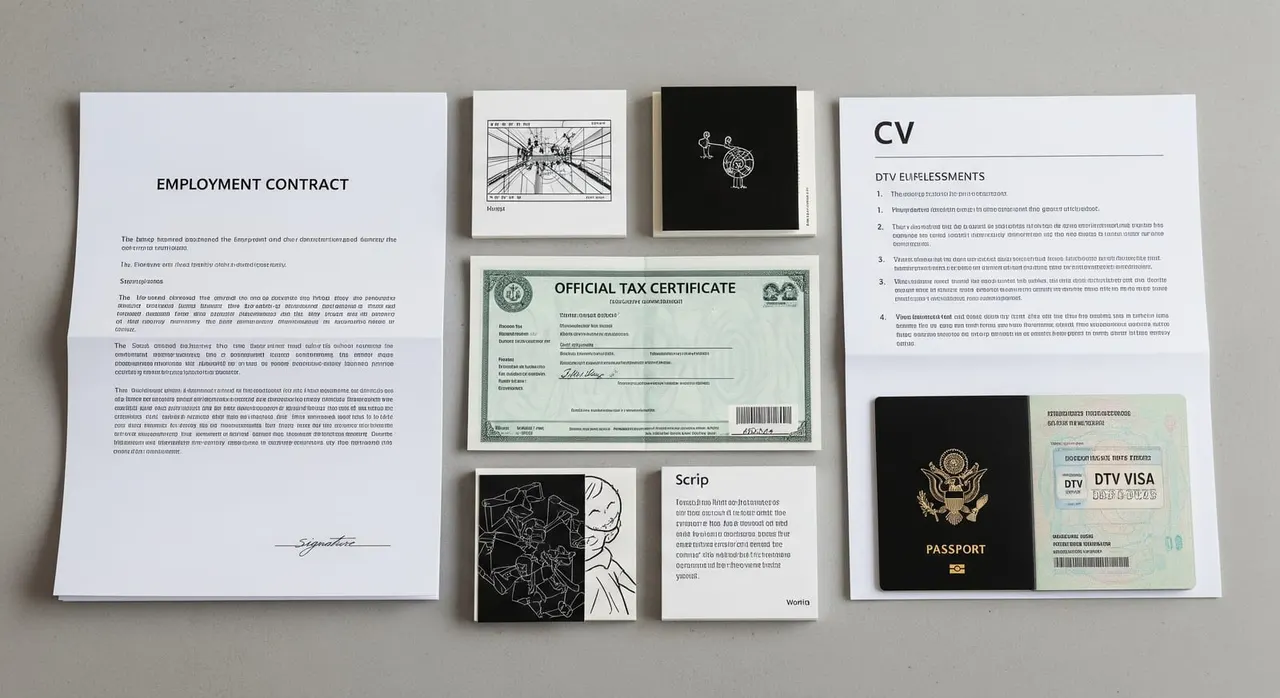
“Provide proof of the DTV holder's employment to verify his/her ability to financially support the dependent, including: an employment contract, CV, income tax certificate, and work samples. All documents must be provided in ENGLISH.”
Why the embassy asks for this
How to provide it correctly
Re-read the embassy email and separate the two asks: (a) the holder's DTV visa copy plus a brief written description of the DTV category, and (b) proof of the holder's employment/income: employment contract, CV, income tax certificate, and work samples. Attach a clear colour scan of the principal holder's valid DTV visa (the e-Visa approval or visa page showing the holder's name, visa type DTV, and validity dates). Write a short plain-English paragraph naming the exact category the holder qualified under — e.g. 'Workcation/remote employment for a foreign company', 'Thai Soft Power (Muay Thai/cooking course)', or 'medical treatment' — and add one line on how it was met. Keep it brief. Gather the holder's signed employment contract or service/freelance agreement showing the holder's name, employer/client, role and remuneration. For self-employed holders, provide client contracts plus the holder's CV. Add the holder's income tax certificate or tax return (the home-country document evidencing declared income) in English, or with a certified legalised translation if originally in another language. Include a representative set of work samples — portfolio items, deliverables, or platform receipts — that match the CV and contract, confirming the same person's claimed work. Confirm every document is in English (or Thai). Any foreign-language document must have a certified translation that is then notarised; an uncertified DIY translation will be rejected. Check internal consistency: the name, employer, dates and income figures on the visa, contract, CV, tax certificate and work samples must all match the same holder without contradictions. Upload all files to the same e-Visa application thread or reply to the exact request email by the deadline as one labelled bundle (e.g. 'Holder DTV visa', 'Category description', 'Employment contract', 'CV', 'Tax certificate', 'Work samples'), and keep a copy of what you sent.
Common mistakes that cause rejection
Treating this as a relationship-proof request and resending only the marriage/birth certificate, when the officer wants the holder's employment proof. Assuming the holder's already-approved DTV visa makes income proof unnecessary; the embassy explicitly re-requests it. Submitting documents in the holder's native language because they are 'official', ignoring the requirement for English or legalised translation. Writing a long defensive essay relitigating the original DTV approval instead of the requested brief category description. Over-submitting every personal and financial document 'to be safe', violating the rule of sending only what was asked and inviting new follow-up requests. Inconsistencies across the bundle — name variations, employer changes, income mismatches, date clashes — which signal a fabricated or unverifiable case.
Frequently asked questions
Why is the embassy asking for the DTV holder's income documents when the holder already has a DTV?
Do the holder's documents really have to be in English?
What should the 'brief description of the category you selected' actually contain?
Can I just send a salary slip or an employer letter instead of the contract and tax certificate?
Should I add extra documents to strengthen the case?
What happens if this request is answered weakly and the dependent is refused — can we just reapply?

Get this document right the first time
Let our team prepare and check your response to the embassy — apply from $139, with a 100% refund if denied (with the optional Denial Protection add-on).