



Consent / Remote-Work-Only Acknowledgement Letter
Unsure how to write your DTV consent letter? Learn the exact remote-work-only wording embassies expect and avoid rejection with our step-by-step guide for the DTV.

What the embassy asked
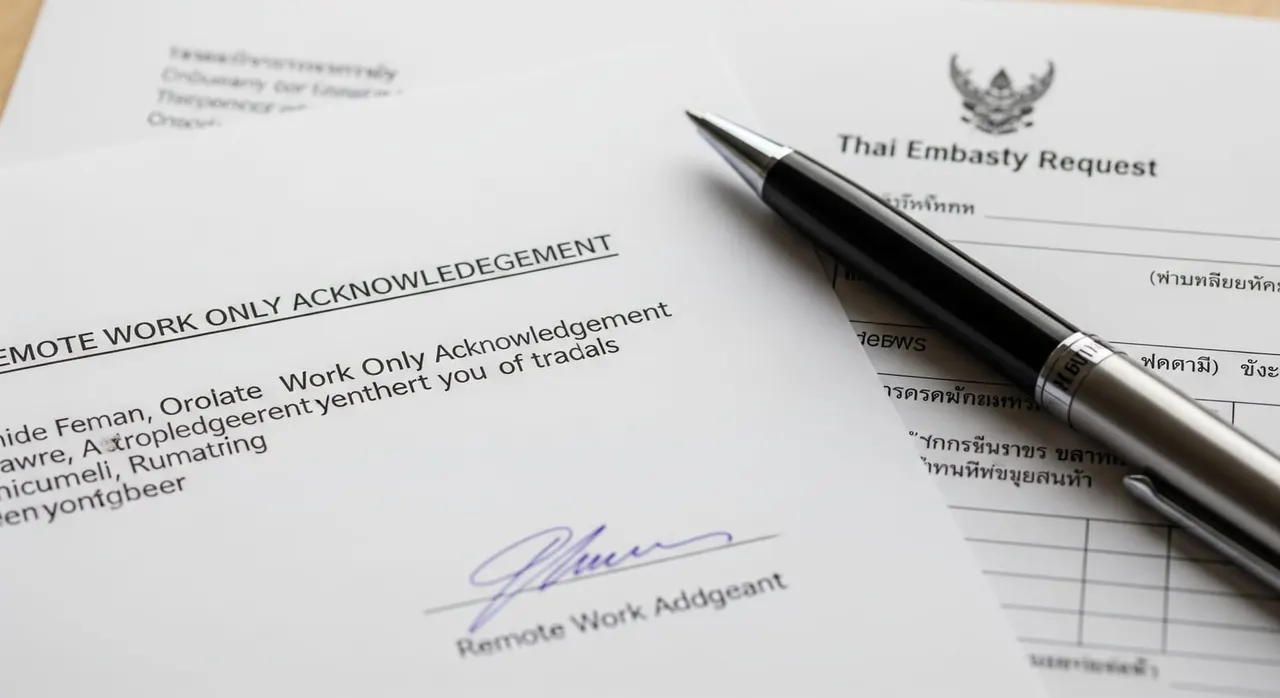
“Consent letter introduce yourself and acknowledge that can work remotely only and will not engage in any employment, business activities, income-generating work with Thai clients, customers in Thailand and will not be in contravention of local Thai laws.”
Why the embassy asks for this
How to provide it correctly
Read the embassy’s email carefully and identify which letter(s) it asks for — the ‘remain in country’ consent, the ‘remote-work-only’ acknowledgement, or both. Submit only what was requested. Write each letter on a single page, in English or Thai, dated with today’s date, and addressed to the exact office named in the email (e.g., ‘Royal Thai Embassy, London’). Sign by hand with your full passport name. For the consent-to-remain letter, state clearly that you understand you must remain in your applying country until your DTV application has been processed and will not travel before a decision is issued. If the email mentions a rescheduled e-ticket or interview, add that you are ready to comply. For the remote-work-only acknowledgement, introduce yourself (name, nationality, occupation or freelance work) and explicitly confirm you will work remotely only for foreign employers/clients and will not engage in any employment, business activities, or income-generating work with Thai clients or customers in Thailand. Keep wording consistent with everything already in your application — same employer name, same freelance status, same intended stay — so the letters don’t contradict your contract, bank statements or DTV form. Save each letter as a clear, readable PDF (or the format the email specifies) and upload it through the channel named in the request — typically a reply to the embassy email or the e-Visa portal — before the stated deadline. Do not attach extra documents such as bank statements, IDs or portfolios unless the email specifically asks for them; adding unrequested material can slow your review.
Common mistakes that cause rejection
Assuming both letters are always needed — read the email; some offices ask only for one. Treating the consent letter as optional and booking travel out of the applying country before a decision. Sending an employer’s remote-work confirmation letter instead of your own personal signed acknowledgement. Using loose wording in the remote-work letter that doesn’t explicitly exclude Thai clients/customers. Addressing the letter to the wrong office or to a generic ‘Thai e-Visa’ instead of the embassy that requested it. Adding unrequested attachments like bank statements or IDs, which can slow the review.
Myth
The remote-work letter must be notarized.
Fact
Frequently asked questions
Do I really have to stay in my country until the DTV is decided?
What exactly should the remote-work acknowledgement say?
Can I just send my employment contract instead of writing the letter?
What language and format should the letters be in?
The email mentioned a rescheduled e-ticket or interview — what is that about?
What if the embassy asked for both letters? Can I combine them?
I already got a request, sent something wrong, and was refused — can I just reapply?

Get this document right the first time
Let our team prepare and check your response to the embassy — apply from $139, with a 100% refund if denied (with the optional Denial Protection add-on).