
Skip to content
Thai Embassy Document Request · Dependent & Family

China Notarized (双认证) Marriage Certificate for the DTV

Received a request for a dtv china notarized marriage certificate? We explain the dual-authentication (双认证) step by step for your DTV dependent. Get it right.
DTVDTVThaiVisa 13 min read

Your DTV dependent application just received a Request for Further Document asking for the notarized (双认证) marriage certificate . This is a standard request from the Royal Thai Embassy when a plain Chinese 结婚证 is uploaded. Don’t panic—we’ll guide you through exactly how to provide the dual-authenticated version, step by step, so your application stays on track.

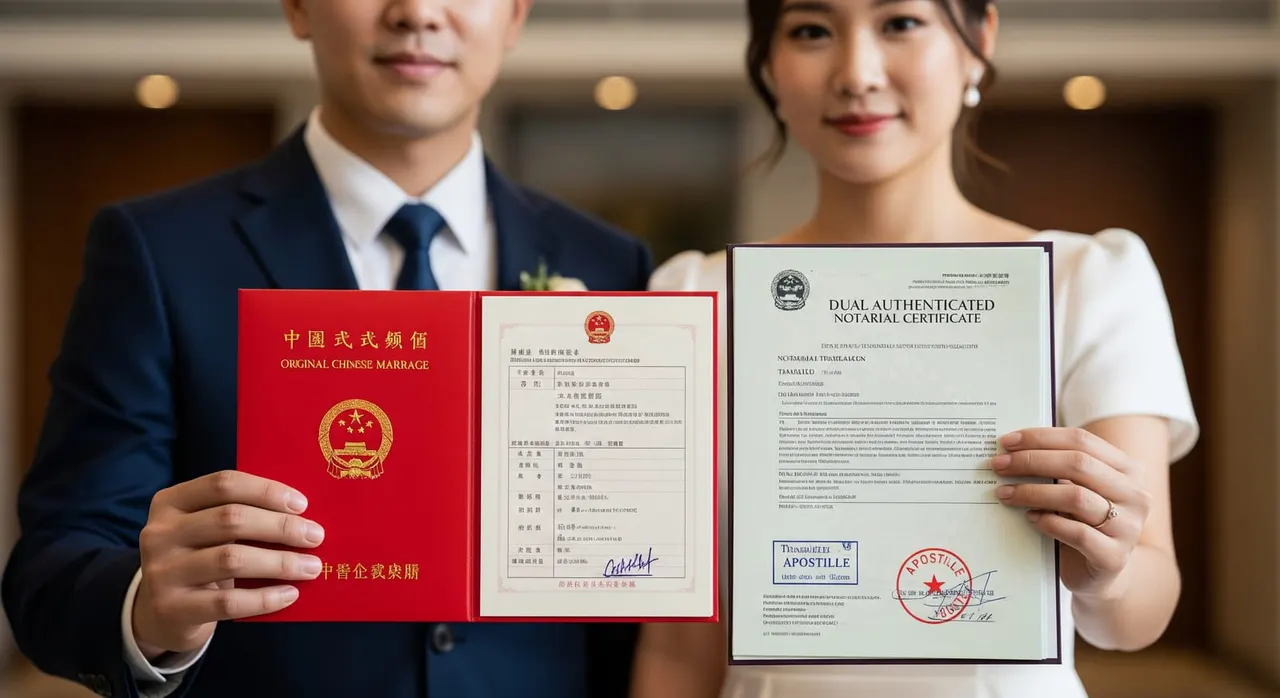
A couple holding an original red Chinese marriage booklet and a dual-authenticated notarial certificate with translation and Apostille page, illustrating the DTV marriage certificate requirement.

What the embassy asked

You received a message from the Thai e-Visa portal or an embassy officer requesting a specific version of your marriage certificate—not the plain red booklet you originally uploaded. It asks for the 'notarized (双认证) version' that proves your relationship to the principal DTV holder in a readable, verified format.

“Kindly provide the notarized (双认证) version of the certificate of marriage.”

Why the embassy asks for this

A Chinese marriage certificate (结婚证) issued by the Civil Affairs Bureau is a domestic document in Chinese without international legal effect. The Thai embassy cannot read it or verify its authenticity. By requesting the notarized (双认证) version , they want a notarial certificate with a certified English or Thai translation, plus a second authentication layer from the Chinese MFA. This guarantees both readability and that the marriage is genuine, preventing fraudulent dependent claims.

Because the DTV is a 5-year visa that allows family reunification, the embassy must confirm your relationship to the main applicant beyond doubt. The dual-authentication chain turns your local booklet into a document with international credibility.

How to provide it correctly

  1. Confirm exactly what the embassy asked for: submit only the notarized, dual-authenticated marriage certificate in Chinese-English or Chinese-Thai. Do not re-send other documents.
  2. Take your original 结婚证 to an authorized Chinese notary public office (公证处) that handles foreign-related documents. Request a notarial certificate of marriage (公证书) with a certified English (or Thai) translation bound into the booklet.
  3. Add the second authentication: have the notarial certificate authenticated by the Chinese Ministry of Foreign Affairs (MFA) or an MFA-authorized local Foreign Affairs Office (外办). This makes it 'dual-authenticated'.
  4. If your embassy accepts Apostille (China joined the Hague Apostille Convention in 2023 and Thailand is a member), opt for an MFA Apostille. If they still require old-style consular legalization, follow their exact wording.
  5. Verify the translation: names must match the passports of the dependent and the principal DTV holder exactly, and the marriage date must be accurate.
  6. Scan the full document—every page of the notarial booklet plus the MFA authentication/Apostille page—as a single clear color PDF. Reply through the same e-Visa portal thread or email within the deadline.
  7. Keep the physical originals: you may need to present the dual-authenticated certificate again at Thai Immigration or for future extensions.
  8. If unsure whether Apostille or legalization is required, politely ask the embassy to clarify. It's safer than guessing and risking another request.
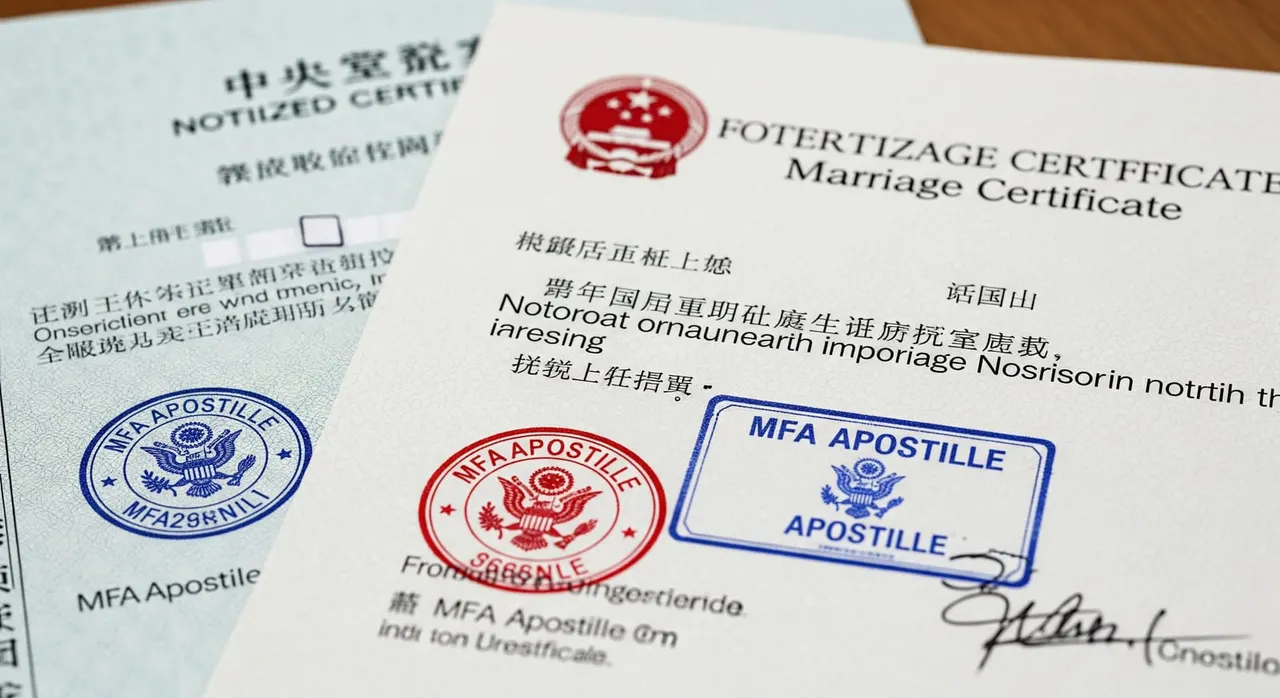
Close-up of a Chinese notarized marriage certificate with an MFA Apostille stamp, showing both authentication layers and an English translation page.

Common mistakes that cause rejection

  • Uploading a plain scan of the red marriage booklet without notarization—the embassy will ask again.
  • Stopping after the notary step and forgetting the second authentication layer (MFA Apostille or legalization).
  • Obtaining a Chinese-only notarial certificate without a certified English or Thai translation.
  • Allowing name transliterations or the marriage date to differ from passport details, which suggests a different person.
  • Adding extra, unrequested documents like bank statements or the principal's work contract, breaking the 'submit only what was asked' rule.
  • Missing the reply deadline or replying outside the original e-Visa portal thread.
  • Assuming an Apostille is never accepted because of outdated information; China and Thailand now both accept Apostilles under the Hague Convention.

Frequently asked questions

What does 'notarized (dual-authenticated)' actually mean for my Chinese marriage certificate?

Two stacked layers: first a notarial certificate (公证书) of your marriage from an authorized Chinese notary office (公证处) with a certified English or Thai translation, then a second authentication on top—an Apostille or legalization from the Chinese MFA or a Foreign Affairs Office. Notary alone is not enough.

Can I just upload a photo of the red marriage booklet to the Thai e-Visa portal?

No. That plain 结婚证 is exactly what triggers the Request for Further Document. The reviewing embassy needs the dual-authenticated notarial certificate in Chinese-English or Chinese-Thai so it can read and verify your relationship to the DTV holder.

Do I need an Apostille or old-style consular legalization?

Since China joined the Hague Apostille Convention on 7 November 2023 and Thailand has acceded, an MFA Apostille on the notarial certificate is normally the dual-authentication layer. If the specific embassy's email still asks for consular legalization, follow their exact wording and ask them to confirm if unsure.

Does the certificate have to be in English?

It must be readable in English or Thai—the request allows Chinese-English or Chinese-Thai. A certified translation bound into the notarial certificate is required; a friend's or machine translation is not accepted.

Should I send anything else along with the marriage certificate?

No—submit only the one dual-authenticated marriage document that was asked for. Adding the principal's bank statements, contracts or unrequested papers breaks the golden rule of sending only what was requested and can slow the review.

I was rejected once after sending only the booklet—will reapplying or replying be harder now?

Reply in the same thread with the corrected dual-authenticated certificate; most document fixes are recoverable once you address the exact cause. In our experience, re-applying after a rejection can feel harder, so get the dual-authentication right before resubmitting rather than guessing.

Get this document right the first time

Let our team prepare and check your response to the embassy — apply from $139, with a 100% refund if denied (with the optional Denial Protection add-on).

Start your application

General guidance only — not legal advice. Thai embassy requirements vary by office and change over time; always confirm the exact wording in your own request email, or let our team check it for you.

Related document requests