Skip to content
DTV Thailand Visa

Non-O Visa Thailand vs DTV: Why Smart Expats Choose DTV in 2025
DTV DTVThaiVisa July 29, 2025 8 min read
Non-O Visa Thailand vs DTV — comparing two long-stay routes to living in Thailand

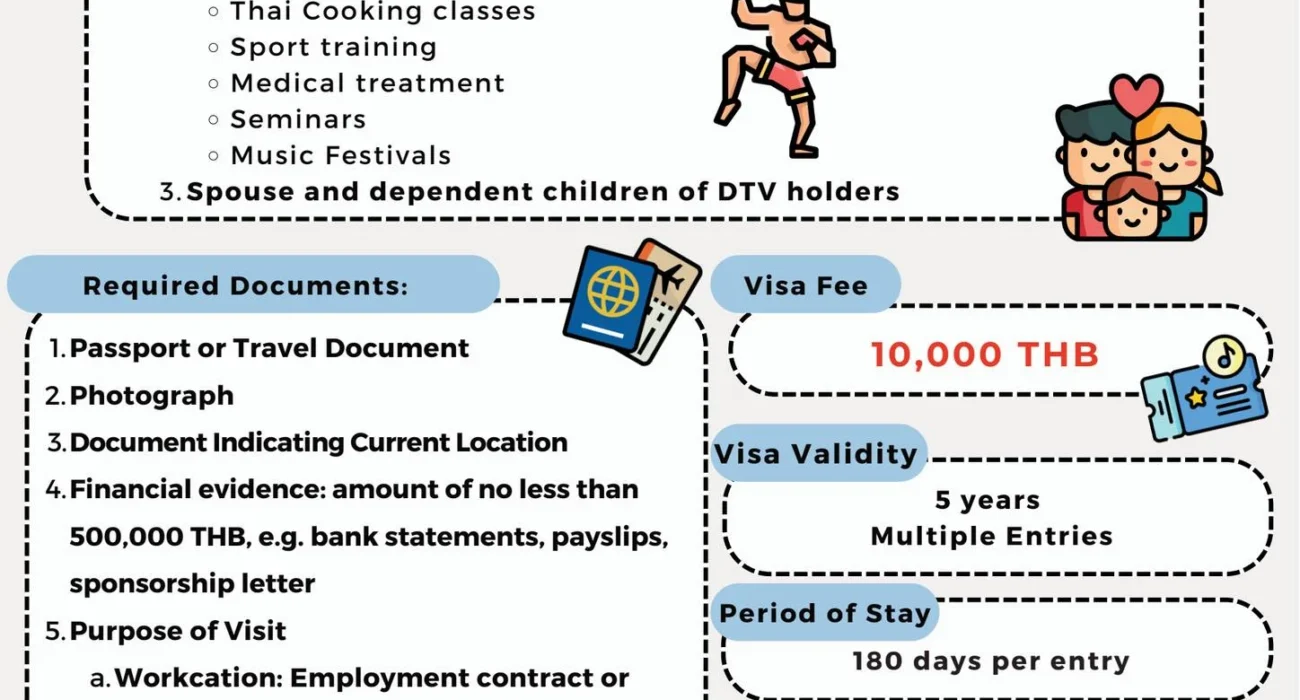
Thailand's newly launched Destination Thailand Visa (DTV) is reshaping long-term stays, offering some clear advantages over the traditional Non-O visa that has shaped expat planning for years. Launched in 2024, the DTV delivers 5-year validity , remote-work flexibility and no age restriction — built for modern, location-independent lifestyles rather than for retirees alone. This guide compares the two across the points that matter most: who can apply, the money you need to show, renewals, travel, work rights and cost.

Age restrictions: the fundamental difference

The clearest dividing line is age. The Non-O retirement visa requires applicants to be 50 or older . The DTV removes that barrier entirely — it is open to qualifying applicants of any age, which is why it has become the default choice for digital nomads and remote workers in their 20s, 30s and 40s.

The financial requirement also differs in a meaningful way. The Non-O retirement route generally expects an 800,000 THB deposit locked in a Thai bank account, while the DTV asks for proof of 500,000 THB (~$15,000) in any personal account — funds that stay liquid and remain available for investments or emergencies.

  • Age: Non-O retirement requires 50+; the DTV has no age limit.
  • Funds: Non-O expects 800,000 THB locked in a Thai bank; the DTV needs proof of 500,000 THB in any international account.
  • Liquidity: DTV funds remain accessible; the Non-O deposit is effectively tied up.

Annual renewals vs five-year freedom

Non-O holders face an annual renewal at the immigration office, and users frequently report long waits at busy centres such as Bangkok's Chaengwattana. The DTV's 5-year validity removes the yearly renewal cycle altogether. Both visas still require 90-day reporting when you stay in Thailand continuously, but the DTV strips away the additional annual paperwork.

Work permissions unlock income

This is where the DTV pulls clearly ahead for working-age applicants. The Non-O visa prohibits employment and income-generating activity . The DTV explicitly permits remote work for foreign employers and clients , legitimising the digital-nomad lifestyle. As a tax note often raised by applicants: staying under 180 days in a calendar year can keep you below Thai tax-residence thresholds — your personal tax position should always be confirmed with a qualified adviser.

Travel freedom vs re-entry permits

The DTV is a multiple-entry visa, so you can leave and return freely without buying a re-entry permit each time. Each entry grants up to 180 days , extendable once per entry by a further 180 days. Non-O holders, by contrast, must obtain a re-entry permit before leaving or risk voiding their visa.

DTV vs Non-O: travel & entry

FeatureDTVNon-O
Re-entry permits Not required Required (1,000–3,800 THB)
Travel flexibility Unlimited Restricted
Advance planning None for re-entry Permit needed before each trip
Stay per entry 180 days, extendable once by 180 Per visa terms

Banking access: a realistic assessment

One honest trade-off: opening a Thai bank account can be harder on the DTV , which is classified alongside tourist-type entries, and recent anti-fraud measures have tightened access generally. Non-O holders often find local banking more straightforward. Many DTV holders simply keep their international bank and a multi-currency card; the situation may ease over time as Thailand adapts to long-stay digital-nomad residents.

Health insurance requirements

The Non-O-A retirement category requires qualifying health insurance — typically a minimum of 3,000,000 THB in coverage including COVID-19, plus inpatient and outpatient cover. The DTV imposes no mandatory health-insurance requirement , turning cover into a personal choice rather than a visa condition.

Cost over five years

Across a five-year horizon the DTV is the more economical route. You pay once for five years, whereas Non-O holders face annual extension costs, mandatory insurance and re-entry permit fees . Non-O renewal services commonly range from 5,000–40,000 THB per year , while the DTV typically needs little professional assistance once approved.

Family inclusion

The DTV makes family stays simpler: spouses and unmarried children under 20 can be included on the same five-year terms. Under the Non-O framework, family members generally have to satisfy the relevant requirements independently, adding coordination and paperwork.

Non-O vs DTV FAQ

Frequently asked questions

Is there an age requirement for the DTV?

No. Unlike the Non-O retirement visa, which requires applicants to be 50 or older, the DTV has no age limit — it is open to qualifying applicants of any age.

How much money do I need to show?

The DTV requires proof of 500,000 THB (about $15,000) in a personal bank account. The Non-O retirement route generally expects 800,000 THB deposited in a Thai bank, where it is effectively locked.

Can I work on the DTV?

The DTV explicitly permits remote work for foreign employers and clients. The Non-O visa prohibits employment and income-generating activity.

Do I need a re-entry permit?

No. The DTV is a multiple-entry visa, so you can leave and return without a re-entry permit. Non-O holders must obtain one before each departure or risk voiding the visa.

How long does the DTV take to get?

Many applicants are approved within a few working days when the application is well prepared. We prepare and submit everything for you from outside Thailand.

Thinking about the DTV instead of a Non-O?

Check your eligibility in a minute, or let our team prepare and submit everything — apply from $139, with a 100% refund if denied (with Denial Protection).

Check your eligibility

Comments

Be the first to leave a comment.